Search This Blog

Showing posts with label HR. Show all posts

Wednesday, November 1, 2023

2023/2024 - HR Trends - What's next?

Every year, the world has it's share of challenges.  HR needs to be able to somewhat anticipate what this means for the organization and the impact it has on staff.

At the start of 2023, Forbes listed the 6 biggest HR challenges as:

  1. Talent Shortages And Upskilling.
  2. Employee Experience
  3. Organizational Agility
  4. Purpose-Driven Work And Workplace
  5. Addressing Workplace Burnout And Mental Health Challenges
  6. HR Digitization

While this does seem to reflect the past year, and perhaps the present concerns, we have to look forward to 2024.


At this point, we seem to be coming to terms with the economy and inflation, but it's certainly not changing fast.  I saw an article from HCA Mag that was titled, "1 in 5 Canadian employers losing out on talent over salary, benefits"

So what do we do?

We need to stay creative!

What are you using for talent attraction and candidate engagement?

What about improving employee engagement? 

Businesses in all industries will need to figure this out to meet these goals and, hopefully, weather whatever economic challenges lie ahead. 

My thoughts would be to start promoting employee benefits as a strategic piece of the puzzle on talent attraction, employee engagement, and retention 

What ideas do you have to help reduce the negative impacts and costs associated with high turnover?

Wednesday, January 23, 2013

Drug testing at TTC

Bring up the TTC to any resident in Toronto, and everyone has a story about a bad experience; it's a big organization that deals with hundreds and thousands of people everyday - it's gonna happen.

Ask a group of HR folks their thoughts on random drug and alcohol testing, and I think you'll be met first with silence before a variety of opinions an experiences.

So what happens when you combine the two?

Well first check out this video from HR Reporter by clicking anywhere in this sentence.

The discussion around it typically comes up in industrial settings like mining or manufacturing; to compare us to the US is like night and day, they apparently test all the time (yes, I know the employment laws are different).


But laws aside for a second, doesn't it make sense ethically for the TTC to do this?

I mean ask anyone who has kids if they are against it, do you really want a 10,000 pound (not verified) steel tube barreling through the suburbs?

I think they should, it would add to their accountability  - especially after that issue around that group who recently got caught issuing false tickets.

But this is my opinion, what do you think? Should public transit workers (anywhere) be subject to random drug/alcohol testing?

Tuesday, April 17, 2012

Creative Problem Solving

I read a study the other day saying that beer makes you smarter.

I'm not one to question science, and this situation is no different - but perhaps a little more insight is needed.

The study, and this testament of 'smarter', was linked to 'creative problem solving'.  Apparently tasks requiring memorization weren't quite so successful. 

So smarter, maybe not; reducing inhibitions and better at coming up with new ideas - absolutely!

I don't think any of us would disagree with this statement - who here hasn't been at the receiving end of a socio-political rant by an inebriated bar fly at some point?


As for this actual study, the amount given to the 'participants' was 2 pints - and the group was males between 21-30 (where would you find such a niche demographic?)

Want to see the actual study for yourself?

Click here

Now before I close this blog, my HR side needs to say this: I'm not encouraging drinking to enhance creativity, nor am I encouraging drinking at work to overcome 'creativity' problems.

Agree? Disagree? Let me know your thoughts.

Wednesday, March 28, 2012

What happens in Vegas... Gets replicated by Toronto?

So earlier this week headlines were made because the Ontario Court of Appeals legalized brothels and ruled that 'sex workers could hire security staff'. 

There is definitely going to be a ton of debate around this over the coming year(s) from the courts to classrooms; the world's oldest profession tends to be a bit of a taboo subject.

The debate for those in favour of this move is that it makes it safer for the ummm... 'front line workers'.

The goal being, supposedly, to empower the people who 'choose' to get into this line of work and to make it safer for them at the same time.

Those against it see it as modeling ourselves after Las Vegas... and the proposed waterfront Casino is only helping that... and generally take a moral/ethical stance in the stereotypes that come from it.

So ya, this is going to be a subject that gets alot of attention and the opinions will no doubt go to both extremes - I don't think anyone would disagree.

However, those of us in HR need to think down the road - what is this truly going to lead too?

If these brothels become legitimate multi-staff businesses (perhaps in their own district) what will the impact be on employment law?

How do you do a reference check?

What screening questions could you ask or not?

What metrics would be looked at during performance reviews?

Obviously I ask these questions with a little sarcasm, but by the same token every business needs to adhere to employment laws.  What would the head of HR look like in that workplace?


I don't know... your guess is as good as mine.

Friday, February 3, 2012

Presenteeism: At Least I Showed Up!

Since the recession hit in the fall of 2008, there has been a general feeling that you shouldn't take vacation or taking breaks at work is the sign of unproductivity.

I get it - people want to keep their jobs and showing up when you feel like crap or really should have stayed home must show dedication... 'who could fire a dedicated employee?' the reasoning might go.

This is known as Presenteeism.

Presenteeism is tougher to address by the simple fact that with Presenteeism the person is physically there at their work station... Absenteeism is self-explanatory.

But think - are any of us above it?

"That project is due on Friday and if I can just make it through this week I can recover on the weekend!"

"I don't want to use up my vacation pay"

"It's just a bit of a cold, I don't have any meetings - I will get over it"

And so on...

It doesn't really matter whether you're talking about a business, school, or medical setting.  Even doctors, nurses, and ambulance workers do it...


So what's the problem?

One study from Cornell University estimated that Presenteeism could account for as much as 61 percent of the total cost of worker illness... Think of that at your workplace alone on an annual basis.

But how often is it addressed?

If you sneeze at the office do people say "oh, you should go home" or is it more like "Oh, I had that last week - is your throat sore?" "Mine was".

Like j-walking, most people don't really seem to address the concern.


So fellow HR Professionals, what do we do?

Friday, December 30, 2011

Hiring for Entry-level HR Position

I'm guessing you landed here because you were looking for an entry-level HR role.  Unfortunately I don't have one to offer at this time.

However I do have some advice, being an HR grad not so long ago... and one that is tired of hearing complaints and seeing postings on LinkedIn about how hard it is to find an entry-level HR role.

The truth is, your degree/diploma doesn't mean much to anyone outside of you, your family, and maybe some of your friends... honestly.

Yes, not having these credentials would limit opportunities even more... but what value is added by having one?

Every spring, recent HR grads (not to mention the other business majors) walk across a similar stage that you did and get their diploma... Thousands of 'em.

You don't need to be an economics major to see the supply and demand picture that is being painted here.

Depressed yet?

Don't be.  If you are reading this and are still in school - then I am the ghost of employment past to show you the error of grads that came before you.  If you did graduate already, give me a sec.

If your school offers a co-op/internship program that aligns with your program take it!  Yes it might add a year to the time that you are in school; see this as an investment in time and not a setback. 

If your school doesn't have this - get one your damn self!  The college I went to had a co-op program, but the co-op department was having trouble finding organizations that would hire (yes, $ not free) students from the HR program... it wasn't even a recession at the time.

So in between classes I applied/emailed/called (yes, I picked up the phone and called) organizations saying what I was looking for in terms of a 4 month co-op placement to get some hands-on experience.

Eventually I found a great non-profit that said they would take me on - but could not afford to pay me.  Some of my colleagues said not to take this, but I said  'Yes!'

I have volunteered before, I will do it again, and plus I had the opportunity to assist with recruitment, learn an HRIS system, network (non-profits are great for this), and update a variety of employee and operational manuals.

Some of my colleagues got paid roles... where they enhanced their knowledge of the alphabet by filing for 8 hours a day... WHo the hell wants to do that? Big picture: this will not enhance your resume.

The same non-profit hired me part-time for a semester while in University, and for a 1 year contract when the HR Manager went on Mat-leave... in hindsight that 4 months of unpaid experience kind of seems worth it, eh?

In summary - be ambitious - don't let your future be written for you.  If you want something go out and get it - now!  Don't wait until graduation to develop a strategy... the job market will never get asier, so the competition starts now.

To those of you that have graduated... what can I say? 

Probably what I say to most business gaduates - don't worry about getting something in your chosen field immediately.  Employers want experience, and if you can't bring it to the table finding something may prove challenging.

Challenging, not impossible.

Leave no stone unturned.  Your Facebook status should say what you're looking for, you should be joining discussions on LinkedIn, you should attend networking events.

Overall, stop blaming the job market.  It is tough, but your attitude has to be tougher.  Your high GPA is great, but without a little grit and determination - you are just one of the thousands of recent HR grads looking for an entry-level position.

Tuesday, November 1, 2011

HRPA Member: To Be or Not to be?

For me the choice is simple - I will not be... but let me elaborate.

As of May 31st 2011 I am no longer a member of the HRPAO - It has been nearly 6 months and it feels great.

In the meantime I have joined another provincial association and will continue to develop in my chosen profession.

Anyone that has read my past blogs knows that over the past year I did several blogs about Bill 138 (Now Bill 28), the HRPAO leadership, and their Customer service (or lack thereof).

Basically, my experiences with the HRPAO was enough for me to not want to be a member any longer.

Here is the story behind my decision:


I graduated from university (only a few years ago) and my next goal was to obtain the CHRP designation and start on the career path of an HR Professional.


It was not long into this journey before the HRPAO would make me question my membership with them, and the value that I would get from it.

I asked questions about national unity for the CHRP, and their Director of Membership and Chapter Relations  tried to intimidate me... I think HR should be about mutual respect and accommodation, and follow some basic customer service protocols.

Following this, the HRPA Members LinkedIn group owner told me to effectively 'shut up'.

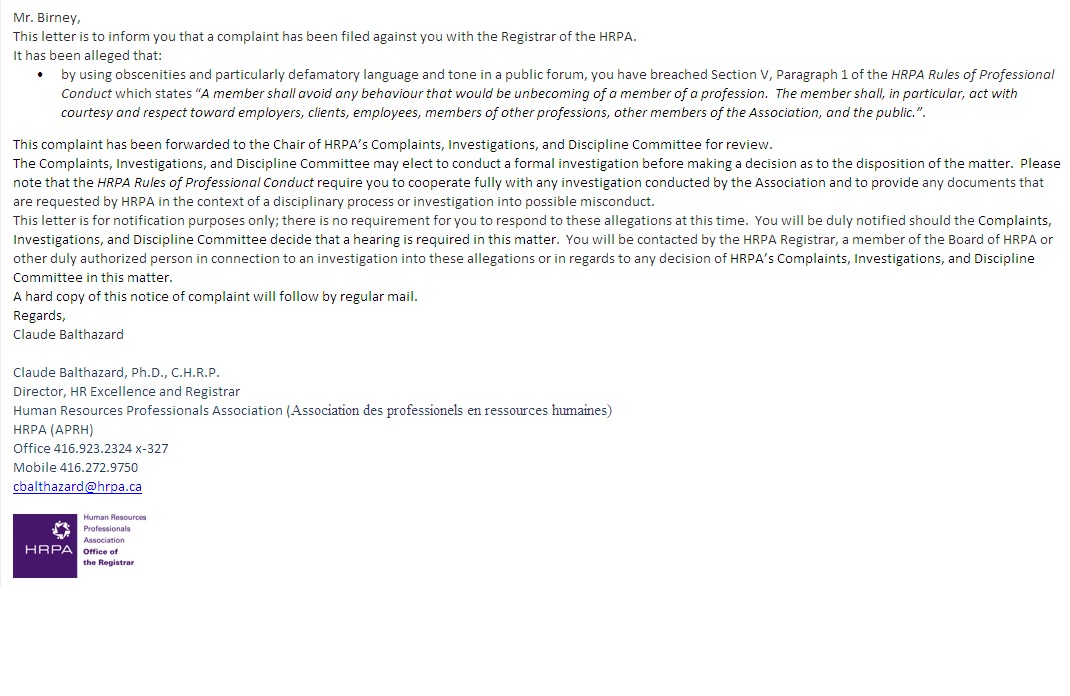
Last year I raised questions about Bill 138 and their Registrar put forth a complaint about me and threatened to put me in front of a committee... For being rude.

Further more, the way the HRPAO board treated the Toronto Board for opposing Bill 138 was absolutely a schoolyard bullying tactic and not representative of good HR/Business practice in any sense.

Who says "Sign this contract saying you won't oppose us - right now!"

Not HR Professionals - that I am for certain.


Dealing with the HRPAO has provided more than enough material to write The Caprano's 2.


This blog is not a sob story, but rather a reflection of the lack of HR leadership at the HRPAO. 

Does this mean I am not going to continue my career in HR?

Not in the least. 

Does it mean I am going to leave the HRPAO?

Obviously it does.

Thankfully, Bill 138 didn't pass.  However, the process around it provided more than enough of a glimpse into the HRPAO's management style; combine this with all the other nonsense I had to deal with and I decided to leave.

Some people have asked me if working towards the CHRP is a worthy endeavour - and my answer is Yes!

I still believe that holding a profession to a standard is a good thing, but that achieving it should be held to a common national standard... seems logical right?

So therefore, go for your CHRP - but remember, membership with the HRPAO is not necessary in obtaining or retaining your CHRP. 

You still can be an HRPAO member - just remember to keep your head down, be quiet, pay your membership dues, and do not question them.

But do you want to be a CHRP or a SHEEP?

As for myself, I will continue to take courses, attend conferences, and network because I think it is a good thing to do in terms of personal and professional development... not because I need recertification points.  It will just not go to the HRPAO leadership - why pay bullies?

Remember, the HRPAO needs members more than members need them.

Do not let their actions deter you from a career in HR if that is what you want to do - we live in a great country and you have (better) alternatives.

I will leave you with a few frequently asked questions surrounding HRPAO membership, the CHRP designation, my decision to leave, and how you can too!


FAQ's:

1. Do I need to be a member of the HRPA/HRPAO to obtain my CHRP designation? 

No.  The HRPA targets membership from other provinces, so why can't it work the other way?

Just keep in mind that if you practice HR in Ontario and have the CHRP designation but membership with another province, you can no longer use the CHRP designation on things like business cards or email signatures (in Ontario).

2. Why did you leave the HRPA/HRPAO?

Dignity.  I believe in standing for what you believe and not being bullied about it; Boycotting the HRPA/HRPAO is the first step any of us can take.


3. How can I transfer my membership/CHRP to another province?

Join the provincial association of your choice, then Contact the HRPA/HRPAO's Registrar Coordinator explaining where you want to transfer it to... Keep in mind the process is different in Quebec, but all other provinces have a transferability agreement.


4. How do I maintain my CHRP with my new provincial association?

Verify with them.  Outside of Quebec, the recertification points/process is relatively the same as it is in Ontario.


5. I don't have my CHRP yet, do I need to join the HRPA/HRPAO?

Not necessarily.  It may be easier to write the NKE if you are an Ontario resident, but all the other provinces (outside of Quebec) still have the NPPA - you could obtain your CHRP designation more quickly based on this.

6. Will I be able to get a job in HR in Ontario if I'm not a member of HRPA/HRPAO?


It hasn't been a problem for me - I have attended several interviews and have identified that I am not a member of the HRPA/HRPAO, that my CHRP is recognized by another provincial assocation and have been fine.  In fact, many senior HR Managers that I have met were not fans of the way Bill138 was 'snuck' in by the HRPA and are happy to hear about how I stood up for myself - It shows individuality and confidence.


7. What will the HRPA/HRPAO do if no one joins their association?

I don't know... probably just use their Twitter accounts to complain about home appliances I guess...

Friday, April 29, 2011

People will be People

I want to start off by saying that I did not wake up early to watch the Royal wedding of William and Kate, but with every media outlet reporting on it missing it has been difficult.

But through my second-hand exposure, what I have been able to reflect on is how alike we all are... regardless of title, wealth, or power - we are all just people.

Prior to the wedding, there was reports of Kate's ... umm... "Eccentric" Uncle Gary Goldsmith and his past

At the wedding there was everyone from Elton John to David Beckham... So what?

At any wedding you go to, everyone will have a relative they really hope will behave... then there is the unpredictable acts that children do:

From Tom Pettifer doing what 8-year olds do best:


To an overwhelmed bridesmaid, Grace Van Cutsem:


But what does this have to do with regards to those of us in the workplace?

Alot.  While all of us aspire and respect people with title's like: VP, Director, CEO, Prince, etc. we are who we are.

While I don't think the words "Can we afford this" ever left Katie's mouth in preparing for the wedding, and most of us will never be involved in any ceremony of this level, at the end of the day it is a wedding between 2 people.

Regardless of title and background, they are just 2 people that found each other and want the best for each other - regardless of their crazy relatives... on both sides.

If I could tie this into the workplace, it would be to say that it is important to remember the human side in everything you do... we are not perfect... and neither are our families.

All the best to William & Kate!

Tuesday, March 29, 2011

Tradeshows & Job Fairs

Hello all,

So spring is on the way... well officially it's here, but weather-wise we have have a ways to go.

Every spring, the minds of young men and women everywhere turns to... um... EMPLOYMENT!

I was a new-grad a few years back, right in the peak of the recession actually, and found it tough.  I'm sure at this point in time it isn't much easier.

That being said, I do recall the Trade Show Displays that would grace my campus every year around this time promoting different companies and possible internships.


For the most part, I found them to be a a frantic tossing of resumes amongst the vinyl banners and would leave with some swag and a ton of pamphlets... but is this helpful? Is it effective?

With this approach I always felt like a number, yet never felt there would be an ROI.

I have blogged about interview tips and how to answer some of the tougher interview questions  that may come up - but this blog is going to be more about approach, or at least my take on it.

1. Start early

If you are in first year, great - you should speak to your career counselor about a co-op or internship program at your school... Experience trumps grades in most cases.

2. Network 

Or as we used to say - make friends.  Meet people from a variety of programs - take advantage of social or extra-curricular things in school.

3. Have an opinion

...and then share it!  Through things like blogs, or LinkedIn, or even Facebook and Twitter - share!  Your name should be able to be found on Google and the results should be positive... Alot of recruiters admit to 'Googling' applicants, so let them see how well-informed and professional you are.

4. Help people

It's the golden rule... what goes around comes around.  However you want to say it, just help other people - it is a good thing to do and may go along way to supporting point #2 above.

5. Be open

When I first graduated, I was very narrow-minded.  I only wanted to work in HR and nothing else; looking at other options and realizing the advantage of being young will open you to other experiences... at the very least you'll have a well-rounded resume


That's my 2 cents... what about my other HR colleagues?

Any advice for our new or soon-to-be grads?

Saturday, March 26, 2011

AODA: What you need to know

Do you have a business in Ontario? Do you have at least one other employee?

Great - listen up!

You have probably heard about the upcoming legislation called the 'Accessibility for Ontarians with Disabilities Act' but may not know everything about it... and not saying I do, but here is what you need to know:

As well, having 'safety signs' posted that let customers know of service disruptions is important.


Fortunately, the Ontario Government has a variety of templates and tools to help you get started.

I know this is specific to Ontario, but it is only a matter of time before similar legislation makes its way across all provinces.

This piece of legislation, I think, is a good thing that in the long run will probably make our lives easier - how grateful are you for automatic doors for example?

What is your organization doing to get prepared for it?

Friday, February 25, 2011

Bill 138 & HRPA... Again

Hello all,

The email below came from the members of the THRPA and HRPYR board today regarding Bill 138... I am not making any edits as I completely agree:

February 25, 2011


Dear Fellow HRPAO Member:

This is a communication about the proposed Ontario legislation, Bill 138, to replace the existing 1990 Bill that establishes the Human Resources Professionals Association of Ontario (HRPAO). We have two concerns:

1) The lack of process -- consultation and communication; and,

2) The actual content of the Bill.

We are very concerned that HRPAO tried to move this Bill through to completion without consultation with the Membership, and without communicating about it. For example, this entire story began with HRPAO preparing a draft Bill and sending it to the Government. They could have, and should have held consultation with Chapters and Members when preparing that. They did not. In fact HRPAO claims that this entire process began with the Government of Ontario drafting legislation. We know that is not true because Bill 138 is not Government legislation; it is a private member's bill. HRPAO claims that events moved so quickly that they did not have time to communicate with us, the Members. Yet almost daily we receive emails from HRPAO on all types of issues -- apparently all more important than this Bill.


You recently received an email from Bill Greenhalgh, Chief Executive Officer, asking you to support Bill 138. Since HRPAO has been telling everyone that the Membership is already supportive, we wonder why they now find it necessary to ask for support – it seems somewhat contradictory. We want to address some of the things that he said:


Before you dismiss these points as being alarmist, please ask yourself. If HRPAO does not intend to use its proposed authority in these ways, for example, to investigate at will, then why are they specifically mentioned in the Bill?

Unlike HRPAO, we believe that it is very important that every Member take time to read and to understand the Bill. This is a far-reaching Act that will affect how each Member, and their employers, can practice or employ HR.

We are in agreement that HR is a profession, and perhaps we need new legislation (although most of the other provinces do not), but we do not have Generally Accepted Accounting Principles (GAAP) like accountants or defined standards of practice as do lawyers or doctors. It is only in the last two years that HR metrics have been made available by our association, and at best those are best practice guidelines, not standards.

But even more concerning than the content of the Bill is the complete lack of process in its introduction. For a profession that is built around fostering openness, collaboration, respect and transparency, the lack of process is extremely troubling.

In addition, HRPAO has been attacking those who ask questions or express concerns. Both the Toronto and York Region Boards (the two Chapters that have been asking questions) have been eliminated. Members have been suspended or lost their Directorship, and had their reputations attacked for questioning the Bill, and/or signing the petition against the Bill. These are not actions of an Association that we want to have more power!

We welcome your feedback. Email us at: hrinontario@gmail.com

What can you do? Educate yourself about the contents of the Bill here.

Read what others are saying:

http://www.thrpa.com/ (the former Toronto Chapter website)

Ian Welsh, (Member and consultant) HR Toolbox Blog click here.

David Doorey (York U Prof) Blog click here.


MOST IMPORTANTLY, if you agree that Bill 138 is flawed, please sign a petition against the Bill available here.

We estimate that less than 50% of the Membership has been aware of the Bill, but of those 50%, over 7.5% have signed the petition AGAINST Bill 138. For a public survey that is a huge number!

IF YOU ARE CONCERNED THAT HRPAO MAY TAKE ACTION AGAINST YOU FOR EXPRESSING YOUR DEMOCRATIC RIGHT TO INDICATE CONCERN (as has happened to others), THE PETITION CAN BE ANONYMOUS – HRPAO WILL NEVER KNOW THAT YOU SIGNED.


Thursday, April 8, 2010

Work-life Balance: ahahahaha!

From the classroom to the C-suite, the term 'work-life' balance has become an increasingly popular concept over the past 5-6 years.

But what is it? does it actually happen?

In a world where a 9-5 existence doesn't really happen I would say that for the most part - no.

Personally, I would say that the the idea of having a work-life balance is a choice.  Like anything else in life, you have to set priorities and determine what you want out of each week.

I'm not saying you have to give yourself a boot-camp-esque like schedule outlining each breath you plan on taking and when, but a little structure never hurts.

The otherside of this is if your job is causing you to work well over 40 hours each week and you're not happy - why are you doing it?  and if you are happy... well really... if you're happy working 50+ hour work weeks for the majority of the year I think you might be lying or you're Hugh Hefner.

Do you feel you have a work-life balance? Does your organization support it in any way?


Wednesday, March 31, 2010

Violence in the Workplace: Is this your problem?

Yesterday in Oshawa, Ontario a 16 year old boy was fatally stabbed in front of his classmates.

What does this have to do with HR? Maybe nothing.  Maybe everything.

I have discussed the new legislation in Ontario surrounding bill 168 before, but I think this incident necessitates a second glance into what HR's role in the workplace is.

Depending on who you talk to, most people would say that if there is a dispute in the workplace - HR should be involved.

But to what extent?

Should it depend on the size of the organization? Should front-line managers be involved?

When we go to work, particularly us 9 to 5ers, we don't expect to be involved in life threatening situations.

So what is HR to do? Do we do some progressive discipline? Is it our job to try and revolve societies shortcomings?

What do you think?

Whose job is it to stop violence in the workplace? Do you think it is a problem in the average workplace?

Tuesday, March 23, 2010

Tough Interview Questions: Knock 'em Dead!

There are questions that get asked by some interviewers that make me cringe - You know the questions that after the interview you're thinking, "Why the hell would he/she ask that?" and you're left paranoid until they call you again.

It's not fun being on the receiving end as the applicant, but you can prepare yourself.

Previously, I had posted some questions on what to ask when the interview is over and it is good to have these in your back pocket, but if you're feeling lost during their questions - you may not have the guts to ask any questions at the end.

That is why you have to prepare!

Mental fear of the unknown is often what produces the physical symptoms of nervousness... ya, we can see you sweating... did you just studder? Not exactly the picture of confidence today, are you?

Okay I'm done.

In addition to preparing yourself physically, you need to prepare yourself mentally. The best way to prepare mentally is to know what may be coming.

Fear of the unknown can only exist when there is an unknown.

Take the time to understand some of these interviewing questions that are designed to knock the average applicant into the dirt.


What is your long-range objective?

Make their job easy for them. Make them want to hire you!

The key is to focus on your achievable objectives and what you are doing to reach those objectives.

For example: Within 4-5 years, I would like to become the very best accountant your company has.  I am presently working towards my designation, to take the steps I need to becoming the expert that others rely upon.

I believe my skills will continuously develop through continuing education so I will be fully prepared to take on any greater responsibilities which might be presented in the long term.


Are you a team player?

Almost everyone says yes to this question, and you're crazy not too; You'll probably be working with a team and they want to make sure you'll fit.  But it is not just a yes/no question. You need to provide behavioural examples to back up your answer.

For example: Yes, I'm very much a team player. In fact, I've had opportunities in my work, school and sports to develop my skills as a team player. For example, on a recent project . . .

Emphasize teamwork behavioural examples and focus on your openness to diversity of backgrounds. Talk about the strength of the team above the individual. And note that this question may be used as a lead in to questions around how you handle conflict within a team, so be prepared.


Have you ever had a conflict with a boss or professor? How was it resolved?

Don't lie and say no.  If you say no, most interviewers will keep drilling deeper to find an example of a conflict - don't go down this road.

The key is your behavioural reaction to the conflict and what you did to resolve it.

For example: Yes, like anyone else I have had conflicts in the past. Never major ones, but there have been disagreements that needed to be resolved.

I've found that when conflict occurs, it helps to fully understand the other persons perspective, so I take time to listen to their point of view, then I seek to work out a collaborative solution. For example . . .

Focus your answer on the behavioural process for resolving the conflict and working collaboratively.


Now for the ass-kicker of all interview questions...

What is your greatest weakness?

I hate this question the most!  Most career counsellors/teachers tell you to select a strength and present it as a weakness.  This is why interviewers get answers like, "I work too much. I am a workaholic that works hard everyday."

Bullshit you do! Seriously, can you smell the BS wafting off that answer? I can!

First of all, using a strength and presenting it as a weakness is deceiving. Second, it misses the point of the question.  And third, you must think the interviewer is an idiot...and they can tell it now.  Be more authentic in tackling this one!

You should select a real weakness that you have been actively working to overcome.

For example: I have had trouble in the past with time-management. However, I'm now taking steps to correct this. I just started making 'to-do' lists at work as well as using a Blackberry...

See how much more authentic that is?


Those are takes on the 4 that I find the toughest - any tough ones that you have had?

Ian

Monday, March 15, 2010

CHRP/SPHR Certification

Do you have an HR designation?

I have found that alot of people, especially those under 30, want to have a designation behind their name to seperate themselves from the competition in the job market.

I personally have my CHRP for this reason, as well as the fact that I think if you are going to be considered a 'professional' in your field, you should subscribe to a certain standard.

That being said, what is the reason you want/have/don't have a designation?

~Ian

Welcome!

Welcome to In Your Face HR!

This blog is for those of you who are in, want to be in, or just have something to say regarding HR practices in the workplace.

This is where you are free to speak your mind, interact, and gain insight to the world of anything and everything HR!

Let's get started!

~Ian